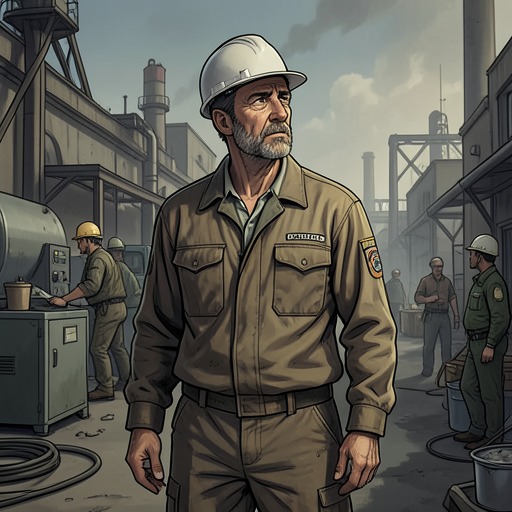
beast of toil
Martin EdenThe expression “beast of toil” gives a name to the transformation Martin Eden undergoes in the hotel laundry: sustained labor reduces a capable, ambitious man to a body and mind organized around work. The phrase is more than a description of fatigue. It marks Martin’s recognition that the labor consuming him is not a route to the higher life he wants, but a force erasing the capacities that made that ambition possible.
Meaning and First Signs
The expression gathers force through a contrast between Martin’s former habits and his new working conditions. He has been accustomed to work that left intervals in which he could think; in the laundry, the hotel manager seems to command his thoughts as well as his time. After one day of fourteen hours on his feet, he tries to read but falls asleep over his book, waking in pain with stiff muscles and chilled by the wind coming through his window. The next day brings another stretch of unremitting labor. Exhaustion is already displacing reading, but the deeper change is that work begins to occupy the whole field of attention.
The pace is learned from Joe Dawson, whose concentration on saving time impresses Martin. Joe shows him how a task can be done in fewer motions, and Martin eagerly adopts the methods. They rub starch out of collars and cuffs, then handle hot starch and cold water in a continuous sequence. Later, Martin catches and backs shirts while Joe operates the tiler, a machine that presses and finishes their yokes, wristbands, neckbands, and bosoms. These are skilled tasks, and Martin proves quick at them; that competence does not protect him from their cost. The work is organized around speed, uninterrupted movement, and eliminating wasted effort.
Labor as a System of Exhaustion
The laundry’s conditions make the expression concrete. While hotel guests sit on broad verandas in cool clothes and sip iced drinks, Martin and Joe work in a room heated by a roaring stove and clouds of steam. They judge the irons’ temperature by holding them close to their cheeks; an iron that would seem hot enough for ordinary household work is too cool for their pace. When an iron is too hot, they dip it in water, where even a fraction of a second too long can spoil its proper heat. The finely calibrated skill of the work serves production, while Martin has little opportunity to pause and reflect on it.
The shirt work extends through long days and late nights. Their hands must repeatedly enter cold water to wring out the hot starch; they iron by swift, measured strokes and keep reaching for the next garment. Martin drinks large quantities of water, yet sweat pours from him. At work, even a brief conversation interrupts his rhythm and makes him miss a stroke. When Joe observes that the place is like hell, Martin is irritated less by the complaint than by the interruption it causes. The sign of the work’s power is not only bodily strain: it has narrowed what Martin can notice, remember, and think.
That narrowing reaches beyond the laundry. During the working day, Martin cannot keep Ruth Morse present in his thoughts; she returns to him only in fleeting memories at bedtime or breakfast. He has no daily paper for a week and, unlike his former self, feels no desire to catch up on the news. The beauty and intellectual spaciousness that had mattered to him seem sealed away. The language of becoming a beast describes this contraction: the worker remains physically active and technically intelligent, but the wider inward life is being crowded out.
The Work-Beast and Its Repetition
On Sundays Martin sleeps in the shade, reads a newspaper without purpose, or lies doing nothing. After weeks of this routine, he feels self-repelled and unable to respond to the sunshine or the sky as he once did. The narrative calls him a work-beast, and the phrase registers a loss of vitality rather than a lack of ability. His ambition has not been disproved; it has been blunted by a schedule that leaves him too depleted to feel its spur.
The weekly pattern offers only a hollow release. At three o’clock on Saturday, the work stops, and Joe goes down to the village to drink. Martin initially keeps his own alternative: he oils his bicycle and rides the seventy miles to Oakland, then covers the same distance back on Sunday. The journey proves no real rest. Across the fifth and sixth weeks, he continues to grind out the hundred and forty miles, while work has left him with only a glimmer of his former self. By the seventh week he follows Joe to the village and drinks too. At the end of three months, the pattern repeats; this time, the drink briefly clarifies what the labor has been doing to him.
Recognition and Reversal
Martin’s decisive recognition reverses the apparent explanation for his decline. He sees the drink not as the original cause of his degradation but as an effect that follows the work as night follows day. The distinction matters: condemning alcohol alone would leave untouched the conditions that have made escape through drink attractive. In Martin’s judgment, becoming a beast of toil cannot carry him to the heights. The labor that might have seemed a test of endurance or a means of advancement is instead destroying the very life such advancement would require.
The reversal becomes explicit when Martin responds to Joe’s proposal to quit and take to the road. He agrees that a hobo’s uncertain freedom may be preferable to life as a beast of toil, because at least it would leave room to live. Joe recalls that being ill with typhoid in hospital had seemed beautiful to him, an earlier expression of how desperately he longs for enforced rest. Martin then changes the telegram to describe them as two laundrymen. The final choice does not erase the weeks of work or turn hardship into an easy escape; it records a changed understanding of what the work has cost.
Narrative Significance
“Beast of toil” binds the laundry’s minute mechanics to the larger conflict between labor and human possibility. The narrative first shows the system through repeated motions, heat, speed, and curtailed rest, then gives those conditions an inward consequence: Martin loses access to reading, memory, beauty, and ambition. His recognition that the drink is a consequence rather than the root cause makes the phrase an indictment of the labor regime, not merely a description of personal weakness.
The phrase also carries a bitter irony. Martin is proud of working quickly and takes satisfaction in matching Joe’s skill, yet the efficiency he learns helps bind him more completely to a life ruled by the next garment and the next motion. His eventual refusal of that identity does not arise from laziness; it follows from the recognition that relentless work has made him less capable of living. In the novel, the beast of toil is therefore both the condition Martin fears becoming and the image through which he understands that endurance alone cannot redeem destructive labor.